—— TAKING A CLOSER LOOK
Substance use is part of health. It has not always been treated like one.
How this works: Read at whatever pace feels right. There are three sections and you can go as deep as you like in each one.
A lot of what we hear about substance use is confusing. It often sounds like "fine" or "addiction," with nothing in between.
But substance use is part of health. Like other health issues, it exists on a range and can change over time. Real life is usually more mixed than what we are shown and told. Here, you can slow down and see the bigger picture.
Before we go further...
You do not have to label anything.
You do not have to decide anything today.
Just start by looking more closely.
READY → Start here
The conversation about substance use has been missing most of the picture.
Here is more of it.
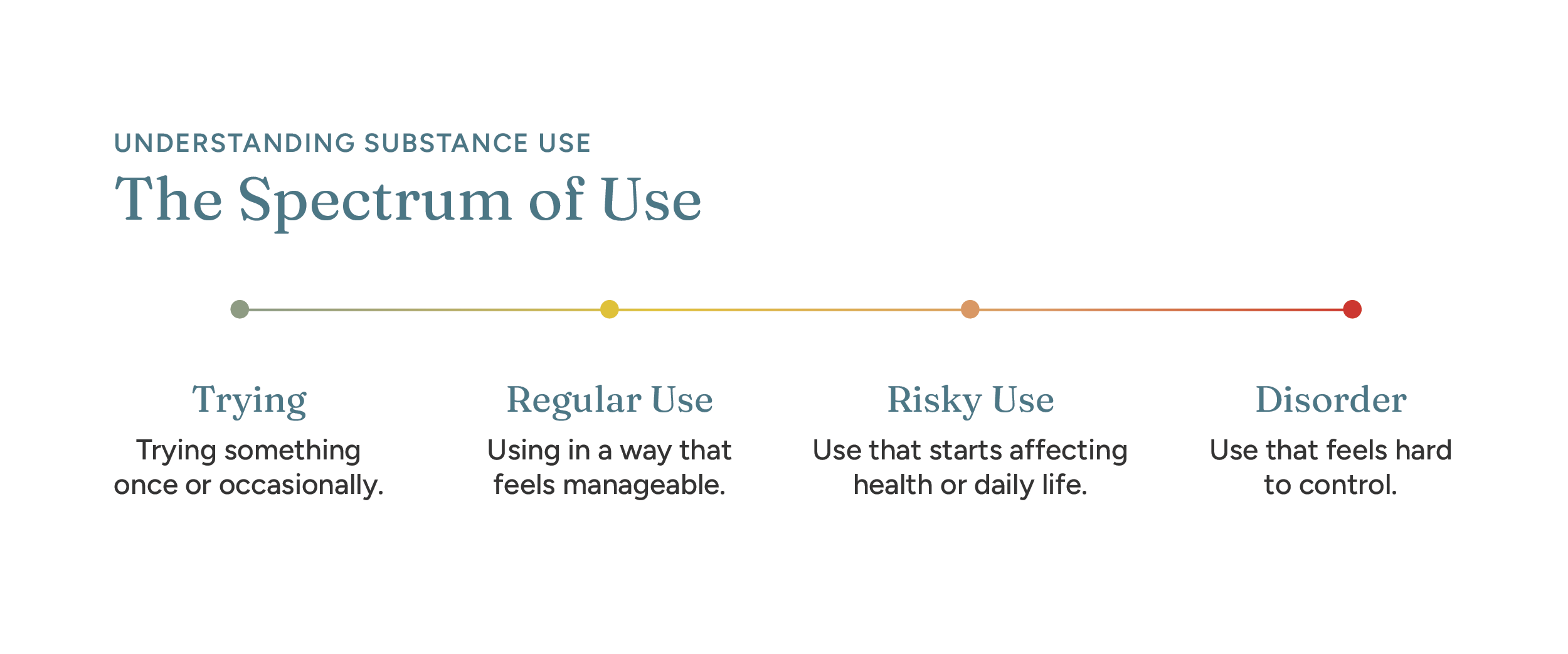
Most people who use substances never develop a disorder. But we built a public health system around the ones who do and left everyone else without a map. That gap does not just affect the majority. It affects everyone. When accurate information is hard to find before things get serious, the path to serious gets shorter.
“People resist help when they feel forced. When we offer information and choices, they are more likely to engage.”
–MISHKA TERPLIN, MD

You already know more than you think
Most people sense something before they can name it. These questions help you look at what you are already noticing.
TAP A QUESTION TO EXPLORE
-
Most of what people hear about substance use lives at one end of the range - crisis, disorder, worst-case outcomes. The middle of the range, where most people's real experiences live, rarely gets named. That gap has made it harder for everyone to see clearly. Not just people in treatment. Everyone.
-
Not all use follows the same path, and not all use progresses. Where someone falls can shift over time. Understanding the range is a starting point, not a conclusion. No labels are needed here. Just a clearer picture.
-
Patterns tell more than single moments. Use becomes more worth paying attention to when it starts shifting. More frequent. Affecting sleep or daily life. Feeling harder to step back from. These are observations, not diagnoses. Noticing early just means more options.
Take your time. There is no right way to do this.
Substance use is a health issue.
It has not always been treated like one.
For a long time the conversation about substance use was built around punishment, not health. Around who deserved care and who did not. Most of the information people have was designed for a crisis. Not for everyday life. Not for the moments most people are actually in.
That is not your fault. It is what was built.
“Trauma, genetics, mental health — these aren't moral weaknesses. They're risk factors, just like high cholesterol increases your risk for heart disease.”
–KRISTINE HITCHENS, Ph.D.
–––WHAT COMES NEXT
There is more to know. And it is worth knowing
The research tells a different story than most people have been given. Not about crisis or failure. About how substance use actually works, how change actually happens, and what actually helps.
Not ready to keep going? That is fine too. Come back when it feels right.